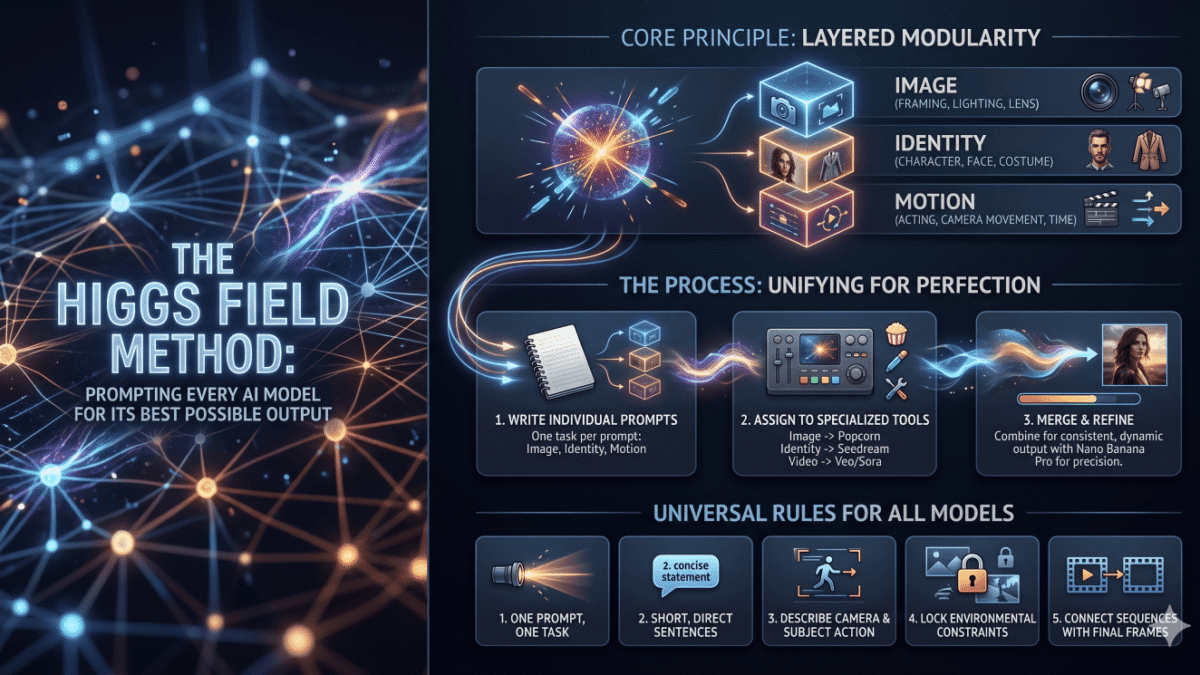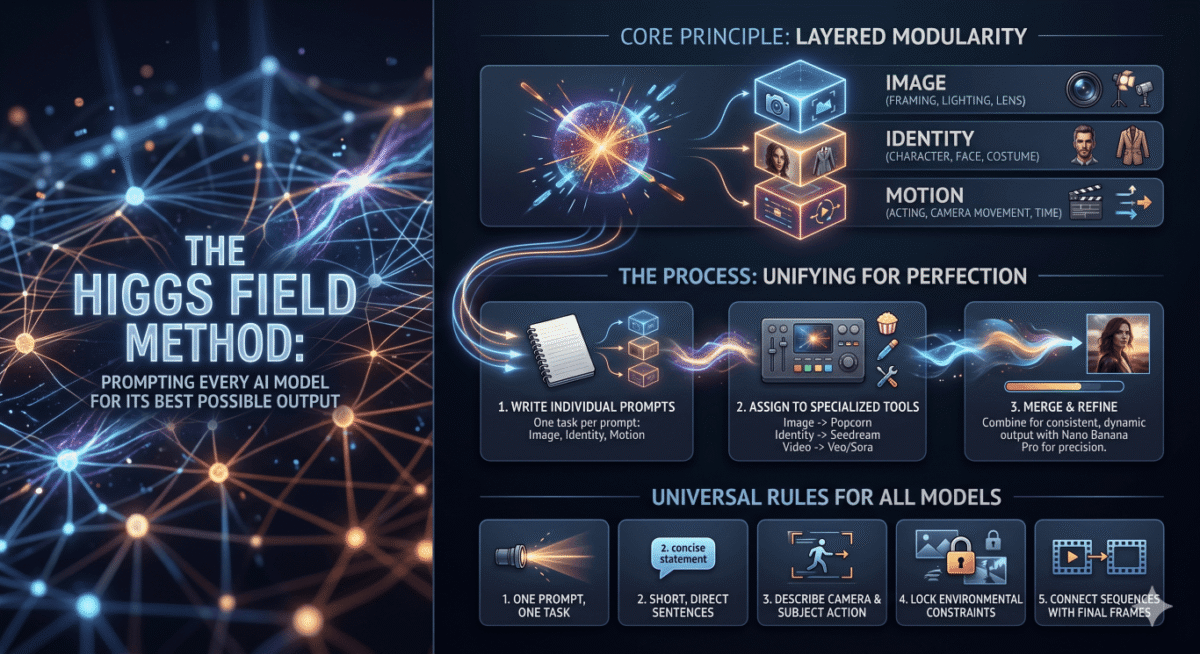
The Higgs Field Method: How to Prompt Every AI Model for Its Best Possible Output
In physics, the Higgs Field gives every particle its mass — its substance, its resistance, its identity. In AI, your prompt is that field. Get it wrong and the model drifts. Get it right and the output has weight.
Why the Higgs Field Is the Right Metaphor
In 1964, Peter Higgs proposed the existence of an invisible field that permeates all of space. Without it, elementary particles would have no mass — they would fly through the universe at the speed of light, unable to form atoms, matter, or anything meaningful.
The Higgs Field doesn’t push particles. It doesn’t tell them where to go. It simply gives them the property through which force becomes form.
Your prompt does the same thing to an AI model. It doesn’t command the model — it establishes the field through which the model’s billions of parameters orient themselves. A weak prompt gives the model nothing to push against. A well-structured prompt creates a field with real density — and the output acquires mass, direction, and substance in response.
The mistake most designers make is treating prompts as instructions. They are not. They are conditions. You are setting the environment. The model is finding its equilibrium within it.
Every strong prompt contains all four layers — context, process, constraint, and feeling. Missing even one reduces the field density and the output drifts.
The Four Layers of a Higgs Prompt: Context (what world does this live in), Process (what should happen), Constraint (what must not happen), Feeling (what emotion should the output carry). Stack all four and the model has no room to default to its training average.
Every Model Has a Different Centre of Gravity
Here is what most prompt guides get wrong: they treat all AI models as interchangeable input-output machines. They are not. Each model was trained differently, on different data, with different optimisation targets. Each has a natural centre of gravity — a type of output it produces with minimal resistance.
Your prompt must align with that centre of gravity, not fight it. Prompting Midjourney the way you prompt Claude is like asking a sculptor to write a novel. The tool will produce something. It will not produce its best something.
Midjourney responds to atmosphere, art reference, and emotional temperature — not logical description. Give it a feeling state, an era, a texture, a lighting condition. It resists technical instruction.
Flux rewards precision. Camera spec, focal length, subject-background ratio, exact colour values. The more technical your prompt, the more control you gain. It handles instruction where Midjourney handles impression.
Claude works best when given a role, a constraint, a goal, and a format to think within. Assign it a perspective. Give it something to push against. Open-ended prompts produce averages; structured prompts produce conviction.
These models think in camera moves and light behaviour. Describe motion as a cinematographer would — the direction of push, the quality of light transition, the frame rate feel. Avoid describing content; describe movement.
ElevenLabs responds to punctuation, pacing cues, and sentence rhythm more than word choice. Short sentences increase pace. Ellipses introduce pause. The emotional weight of VO lives in structure, not in content alone.
Firefly excels at material simulation — paper, fabric, paint, grain, worn surfaces. Use it for environmental textures and fills, not for narrative images. Describe surface properties: roughness, reflectivity, age, application method.
The Same Brief, Six Different Fields
To make this concrete, let us take a single creative brief — a brand campaign for a premium craft coffee company — and write the Higgs Field prompt for each model. Same intent. Completely different prompt architecture.
Midjourney — Atmosphere first
Flux — Technical specification
Claude — Strategic reasoning
Runway — Motion as subject
ElevenLabs — Rhythm over content
Adobe Firefly — Material simulation
The CoreDesk Model Selection Matrix
When approaching any brief, we run it through a simple decision matrix before writing a single prompt. The question is never “which AI tool do I know?” It is “what does this moment in the output need most?”
| Output Need | Primary Model | Prompt Focus | Avoid |
|---|---|---|---|
| Brand mood / hero visual | Midjourney | Era, feeling, light quality | Technical specs, exact measurements |
| Product photography-style image | Flux | Camera spec, surface material, colour grade | Emotional language, art references |
| Copy, strategy, script logic | Claude | Role + constraint + format | Open questions, vague briefs |
| Brand video / motion | Runway or Kling | Camera move, light transition, pacing feel | Content description, narrative |
| Voiceover / audio | ElevenLabs | Sentence rhythm, punctuation, line breaks | Long sentences, passive constructions |
| Texture / paper / surface fill | Adobe Firefly | Material properties, production method | Compositional or narrative prompts |
Five Laws of High-Density Prompting
- 01 Assign the model a point of view before asking for output. “You are…” is the single highest-leverage opening in any prompt. It creates the field before the model begins working. Without it, the model defaults to its statistical centre — which is always average.
- 02 Give constraints, not permissions. “Do not use…” is more powerful than “use…”. Constraints reduce the probability space the model must navigate. A prompt that says “no corporate language, no wellness clichés, no second-person” already eliminates 60% of weak output before generation begins.
- 03 Specify the emotional register, not just the content. Every output carries a feeling state whether you specify it or not. If you do not name it, the model will choose. Name it: “feels inevitable, not salesy” or “carries the weight of understatement.” These are not decorative — they are directional.
- 04 Use reference as calibration, not as instruction. “In the style of Saul Leiter” is a calibration — it tells the model the quality of attention, the colour temperature, the compositional philosophy. Do not use references as replacement for thinking. Know why the reference works and name those properties explicitly alongside it.
- 05 Lock format before content. For any language model, specify the output structure before describing the creative task. Format is a constraint. Constraints create field density. “Three options, each with a headline, one-line rationale, and what it risks” produces radically better output than “give me some headline ideas.”
The Prompt Is Not the Command. It Is the Condition.
The Higgs Field does not instruct a particle to have mass. It simply creates the condition in which mass is possible. Your prompt works the same way. It does not tell the model what to produce. It creates the environment in which the best possible output becomes the path of least resistance.
When you understand that each model has a different centre of gravity — a different kind of intelligence, a different training language — you stop fighting the tool and start working with its natural weight.
Work with CoreDesk →